
Middlesex County Court Records After Arrest
The arrest-to-court path in Middlesex County runs from local police or sheriff custody, to booking, to bail or arraignment, to prosecution review, and then to the trial court. The Middlesex District Attorney's Office prosecutes cases for the Commonwealth across the county. Its official site says the office serves 12 district courts, 4 juvenile courts, and 2 superior courts in the largest county in New England.
Booking and court records answer different questions. Middlesex County jail inmate records concern custody, booking, housing, release, and jail services. Court records after a jail arrest concern charges filed in court, docket events, warrants, case status, and dispositions. Booking photos are a separate jail-records issue handled on the Middlesex County jail mugshots page.
Find Court Records After Arrest
The main public online starting point is MassCourts, the Massachusetts Trial Court Electronic Case Access portal. MassCourts can help locate public docket and calendar information, but it warns that the online portal is not the official court record. For official certified records or a docket that is unclear, contact the clerk's office in the court where the case is pending.
- Start with the defendant's full name, docket number, court department, or calendar date if known.
- Open MassCourts and narrow the search to the likely Middlesex court or criminal case type.
- Read the docket number, charge text, court events, and next scheduled date.
- Compare the court charge to any jail booking charge because the prosecutor may amend, reduce, add, or dismiss counts.
- Contact the clerk for the official court record, copies, or certification.
The public portal is shown in the MassCourts screenshot source.
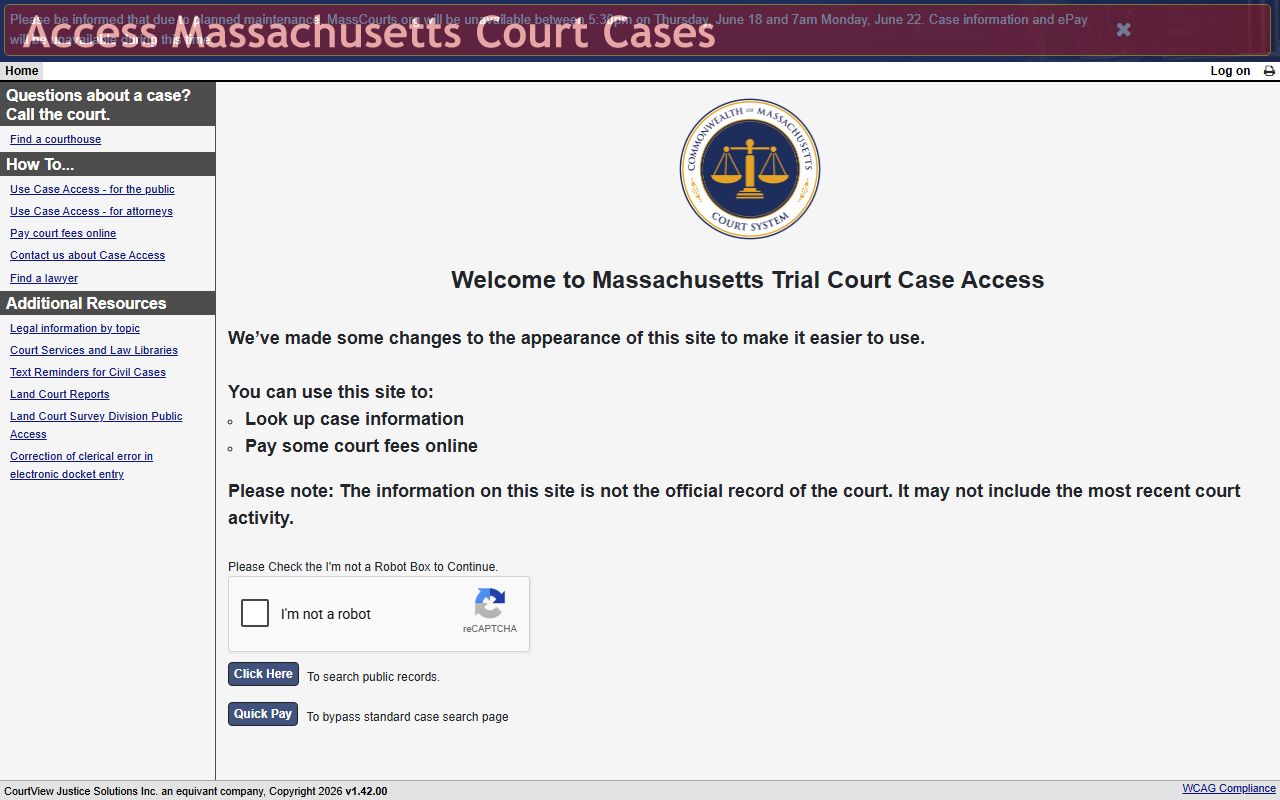
MassCourts is useful for finding a case path, but the clerk remains the source for official records.
Middlesex Court Records Search Fields
MassCourts field availability can vary by search path and court department. For criminal court records after a jail arrest, name and docket searches are the most useful. Calendar searches can help when the arrest is recent and the first appearance or arraignment date is known.
| Field Label | Type | Required | Notes |
|---|---|---|---|
| Court department or division | Dropdown or search filter | Usually for narrowing | Choose the Middlesex court where possible. |
| Case type | Dropdown or filter | Depends on path | Use criminal when searching charge records. |
| Party name | Text | Optional | Use defendant last and first name where available. |
| Docket number | Text | Optional | Best when known from paperwork or clerk. |
| Calendar date | Date | Optional | Useful for arraignment or next-date checks. |
Middlesex DA and Arrest Charges
The Middlesex District Attorney's Office is led by District Attorney Marian Ryan and is based at 15 Commonwealth Avenue in Woburn. The DA's prosecution teams handle cases across district, juvenile, and superior courts. After a jail arrest, the office may file charges, seek an indictment for serious matters, amend charges, or dismiss counts as the case develops.
The DA press-release archive is useful for serious cases because releases often state the charge, defendant age or town, court of arraignment, investigating agencies, and next court date. Press releases do not replace the court docket. They are context for major cases, while the court record is the better source for live case status and disposition.
The DA source is shown in the Middlesex District Attorney screenshot source.
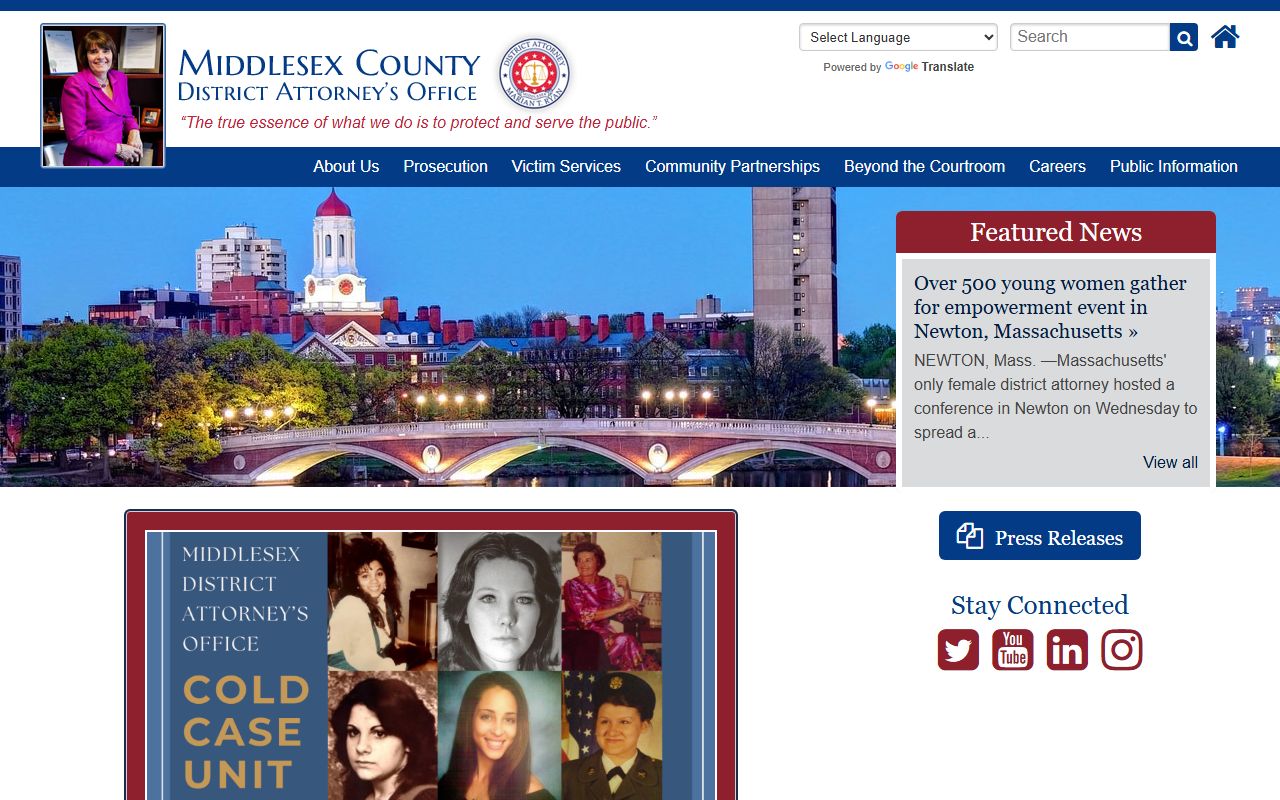
Use the DA site for prosecution context and MassCourts or the clerk for docket detail.
Charges Filed After Jail Arrest
A booking charge is an intake description of why a person was arrested or committed. The court charge is the formal accusation being pursued in court. In Massachusetts practice, a criminal complaint is common in district court, while serious cases may proceed by indictment in superior court. The research did not identify Massachusetts using a generic felony information model as the standard local route, so this table keeps the document types conservative.
| Document | Who Uses It | What It Starts |
|---|---|---|
| Criminal complaint | Court process after police or prosecutor application | A criminal case and docket in the appropriate court. |
| Indictment | Grand jury in serious cases | A superior court felony prosecution. |
| Probation or default warrant entry | Court or probation process | A warrant or violation path tied to an existing docket. |
Middlesex Charge Status Records
Charges can change after arrest. A prosecutor may file fewer charges than the booking sheet showed, add counts after review, reduce a charge, amend a statute reference, dismiss a count, or enter a nolle prosequi. A charge is not a conviction. It is an accusation that must still move through court, plea, dismissal, trial, or another disposition.
| Status | Meaning |
|---|---|
| Pending | The court case or count is open and not finally resolved. |
| Amended or reduced | The charge changed from the original filing or booking description. |
| Dismissed | The court ended the count without a conviction. |
| Nolle prosequi | The prosecutor chose not to continue that charge. |
| Disposed | The count or case has a recorded outcome. |
Bail After Middlesex Arrest
The jail page gives specific bail posting rules for people held at the Middlesex Jail & House of Correction. Bail must be posted at the Visiting Center between 6:30 p.m. and 7:00 p.m., no later than 7:00 p.m., Monday through Sunday. All bails are cash only at the jail window, and the person posting bail must show valid government-issued photo ID. Questions after 4 p.m. and on weekends go to 978-667-1711, extension 0.
| Release Issue | Middlesex or Massachusetts Note |
|---|---|
| Cash bail | The sheriff states jail bail posting is cash only during the posted evening window. |
| Personal recognizance | A court may release a person on a promise to appear with conditions. |
| Conditions of release | The court may impose reporting, no-contact, location, or other conditions. |
| Hold or no release | Another warrant, probation matter, federal hold, immigration detainer, or no-bail order can block release. |
Warrants After Middlesex Arrest
The sheriff website navigation includes a Warrant Apprehension Unit, but the research did not locate an official public active-warrant search portal for Middlesex County. Warrant details may appear in court records when tied to a docket. A person worried about an active warrant should use the court clerk, the arresting police agency, or legal counsel rather than relying on unofficial lists.
When a warrant leads to an arrest and commitment to Billerica, the jail becomes the immediate custody point. The court record can then show the issuing court, docket, reason for default or bench warrant if public, next event, and release conditions if set. Some warrant records may be withheld or redacted if disclosure would compromise enforcement.
Charges vs Convictions
Charges and convictions are not the same. Court records after a jail arrest may show accusations that have not been proven. A conviction appears only after a guilty plea, verdict, or other qualifying disposition. Treat each docket entry as a stage in a case, not as a final result unless the disposition clearly says so.
| Charge | Conviction | |
|---|---|---|
| Stage | Accusation filed in court | Final guilt finding or plea outcome |
| Proof | Not a finding of guilt | Based on plea, verdict, or qualifying disposition |
| Record use | Needs context and current status | Still must be checked for sealing, appeal, or correction |
Sealed vs Expunged Records
Massachusetts has separate concepts for sealing and expungement. Sealing limits public access to many criminal records when legal conditions are met. Expungement is narrower and can erase or destroy a qualifying record for statutory purposes. The official path for statewide criminal history is CORI through DCJIS, and individual CORI requests may take up to 10 business days according to the research file.
| Sealed | Expunged | |
|---|---|---|
| Effect | Public access is limited. | The record is erased or destroyed if eligible. |
| Statute | M.G.L. c. 276, section 100A | M.G.L. c. 276, section 100E |
| Best source | Court or DCJIS records process | Court or DCJIS records process |
Restricted Court Records After Arrest
Not all court or law-enforcement information is public. Juvenile records, sealed cases, certain victim-related records, domestic violence or sexual assault details, ongoing investigations, and safety-sensitive information can be withheld or redacted. Massachusetts Public Records Law and court access rules require a record-by-record review rather than a blanket rule that every arrest detail is online.
Important: Do not use casual court or jail lookups for FCRA-covered decisions such as employment, tenant screening, credit, or insurance.